by Nayoung Weaver and Rama Ndiaye | Jan 24, 2022 | Blog
What does it look like when a coalition of anti-racist educators take on the task to end racism, discrimination, and inequities in the international school ecosystem?
The Women of Color in English Language Teaching (WOC in ELT) and the Association of International Educators and Leaders of Color (AIELOC) organized their second annual two-day November conference on Saturday, November 13, and Sunday, November 14, 2021. Every session focused on representation, justice, anti-racism, and equity in international schools. The following was the agenda:
| Saturday, November 13, 2021 (Eastern Time) |
| 9:00am-9:15am |
Rama Ndiaye and Nayoung Weaver, Opening |
| 9:15-10:15am |
Darnell Fine, “Day of Absence”: A Retreat for Communities of Color to Unpack Internalized Racism |
| 10:20-11:00am |
Ceci Gomez-Galvez, Language Equity: Redefining our Language Learning Practices to Empower Multilinguals |
| 11:05-11:35am |
Tiwana Merritt and Constance Collins, Countering Savior Mentality: Critical Engagement in Our Local Communities |
| 11:40-12:10pm |
Xoai David, Persistence – ODIS Collective and the IB, One Year Later |
| 12:35-1:05pm |
Fernanda Caetano, Fostering Belonging in the classroom through rapport and decolonial perspectives |
| 1:05-1:50pm |
Sherri Spelic, At Home and Away: Building Connections That Allow You to Thrive Year Round |
| 1:55-2:25pm |
Dominique Dalais, Conversations with an International Teacher of Colour – Discussions on Diversity, Equity, Inclusion and Anti-Racism |
| 2:30pm |
Fandy Diney, Closing |
| Sunday, November 14, 2021 (Eastern Time) |
| 9:00am-9:10am |
Abha Kelkar, Aiko Yamakita, Baya Khodja, Constance Leung, Justin Garcia, Kristina Pennell-Götze, Nayoung Weaver, Rama Ndiaye, Tulika Bathija, Opening by the Radical Dreamers |
| 9:10-10:00am |
Margaret Park and Jessica Huang, Leadership and Intersectionality: How Gender and Race Impact Women in Leadership |
| 10:05-10:50am |
Joel Llaban, Nurturing the Courage to Lead |
| 11:00-11:45am |
Leadership Panel moderated by Grace Wilson, Kam Chohan, Dr. Megel Barker, Dr. Erin Robinson |
| 11:50-12:35pm |
Dr. Fernanda Marinho Kray and Dr. Christine Montecillo Leider, Creating a Space of Our Own: Enraizando Social Justice as Resistencia in Neoliberal Contexts of Education |
| 1:00-1:30pm |
Ann Marie Christian, Identity, Well Being and Safeguarding our Children |
| 1:35-2:25pm |
Giancarlo Picasso, Our Purple Couch: The Learning Hub for Gender and Sexuality at International Schools |
| 2:30-2:50pm |
Mehar Suri, EmoEmpathy: A New Lens of Teaching Anti-Discrimination, Sexuality and Consent |
| 2:50pm |
Mona Fairley-Nelson, Closing |
Joel Llaban Jr’s quote: “Listen to the silence, the silent, and the silenced,” strongly resonated in this conference. The conference was successful in giving voice to those who are often marginalized and de-centered from the mainstream narrative. By empowering and amplifying the experiences of historically marginalized folks, the sessions provided us with ways to stay in our truth in order to do the work authentically. Below is some feedback from the conference participants explaining how they have been inspired to make changes within their ecosystem:
- I’ve learned so much in this conference, I think that the critical service learning is something I will apply now by bringing it intentionally to my units.
- There was so much learned over this past weekend. I shared information from Xoai David on decolonizing the IB curriculum as well as the information and Padlet from the lady who presented on languages.
- Affirmed that silence is not an option. I don’t have to burn stuff down, but it serves no one to allow harm to go unchecked.
- I continue to hear a lot of resistance to CRT, anti-racism, anti diversity training here in the states. The more I know, it provides me knowledge to help feel empowered to counter their misconceptions.
- As the language department chair I’d like to bring the discussion about how we, as language teachers, can offer support for faculty in translanguaging and multilingual strategies.
- I want to review some of the sessions that I missed first and then take some golden nuggets from each one and begin to build my ELT toolbox.
- My student who attended is keen on a day of absence which would be really interesting.
- The “Day of Absence” was mind blowing for me.
- The time together was affirming and uplifting.
- Healing experiences for teachers, as we cannot serve from an empty plate.
- The best parts: exchanging with so many diverse people, having a platform to talk about important issues
During this professional learning weekend, facilitators helped participants understand the anti-bias/anti-racist framework authentically. The gathering was a platform for educators to reflect, learn and discuss ideas focused on lived experiences of justice, equity, diversity, and inclusion within international education. The powerful weekend of teaching and learning instilled that, as members of the international school ecosystem, it is our profound duty to create a more sustainable world rooted in love, compassion, and restorative justice. Educators collected the tools necessary to confront and actively participate in dismantling deeply rooted systems of oppression to liberate future generations.
We offer our deepest gratitude to our presenters, moderators, partners, and attendees. To find out more about WOC in ELT, please go to https://womenofcolorinelt.wordpress.com/. To find out more about AIELOC, please go to https://aieloc.org/.
by Kevin Simpson | Oct 12, 2021 | Blog

The flagship Outstanding Schools Middle East Conference returns this October to showcase regional and international best practice, provide a platform for thought-provoking and inspiring conversations, and facilitate more networking opportunities than ever!
This 3-day conference is the must-attend event for Principals, Academic and Pastoral Heads, Heads of Primary and Secondary, and Heads of Department from international schools across the Middle East, to learn, connect, and collaborate around the following four themes:
Teaching & Learning | Inclusion & Wellbeing | Leadership & Management | Workforce & CPD
by Nayoung Weaver and Rama Ndiaye | Sep 18, 2021 | Blog
By Nayoung Weaver & Rama Ndiaye – AIELOC Fellows
“Education […] helps people to understand the character of the oppressions, exploitations, exclusions, and destructions committed against humanity.” – excerpt from the AIELOC Equity Statement
We just want to be teachers. We entered this profession to give hope to our future generation. One of our biggest desires is to help our learners discover that critical thinking skills along with well-rounded knowledge are tools that can improve humanity as a whole. As the AIELOC equity statement highlights, students need these tools to understand the permanent oppression and exploitation present in the world in order to dismantle them.
We just want to be teachers because empowering learners with global, historical, and cultural contexts and understanding is one of the best ways to improve our society.
We just want to be teachers because one of the most rewarding aspects of our profession is witnessing learners flourish as they discover the different ways in which their humanity is valued and that they, too, can have a positive impact on our world.
We just want to be teachers because we know that fostering our students’ global-mindedness can help them cultivate progress and cherish, with love, the importance of our interconnectedness and our shared humanity.
We just want to be teachers. Yet, since Diversity, Equity, Inclusion, and Justice (DEIJ) became more globally mainstream, marginalized international educators spend more time and precious energy towards dismantling racist systems that have taken centuries to build.
We just want to be teachers. Unfortunately, the burden of a meaningful, well-established, and culture-wide anti-racist school environment continues to fall on BIPOC and other historically marginalized educators and leaders. This oppressive practice can no longer be the norm.
This open letter is a call to action to all members of the international school ecosystem:
- To white educators and leaders:
- Turn to each other and reflect on your prejudices;
- List your privileges and meaningfully use them every day to support educators, students and families of color;
- Be humble when marginalized educators and leaders share their stories. Take it for the love that it is and attentively listen to their lived experience;
- Be aware and self-reflect on your fragility when marginalized groups need their own space;
- Fight for hazard pay for marginalized individuals;
- Support humans over institutions.
- Seek out and learn BIPOC stories and intentionally de-center dominant narratives.
- Work to dismantle the racist system not serving all
- To BIPOC educators and leaders:
- Understand and reflect on your internalized oppression;
- Fight the impulse to continue laboring under the white gaze;
- Find safe and brave spaces to keep telling your stories;
- Reach out to marginalized students;
- Heal: invest in your self care;
- Create solidarity with each other;
- Amplify and uphold each other;
- Disrupt discriminatory practices as a team.
- To white DEIJ consultants:
- Educate every client about your privilege;
- Give up your platform to BIPOC consultants;
- Amplify the voices of anti-racist BIPOC;
- Consistently and continuously educate yourself about your role in this white supremacist world.
- To accrediting organizations:
- Hire BIPOC-vetted and anti-racist accreditation peer evaluators (such as consultants from AIELOC);
- Seek out the voices of BIPOC international educators at every school you accredit;
- Require all international school human resources (HR) offices to be trained in and comply with anti-racist philosophies;
- Officialize community voices – especially those from marginalized communities – as part of the accreditation assessment;
- Tie accreditation with meaningful anti-racist work (if you do not know what that is, return to self-reflection and come back to it);
- Hold institutions accountable by providing conditional accreditation or by taking it away;
- Recommend boards of schools to dismiss leaders who continue to be performative in their anti-racism work.
- To international recruitment agencies;
- Advocate for qualified, racially, and ethnically diverse educators. If they cannot meet these needs, provide support to allow candidates to seek alternative organizations;
- Seek out and listen to marginalized voices regarding fairs, recruitment processes, retention, etc.;
- Be transparent about recommendation letters;
- Hold schools accountable that are not hiring or retaining diverse educators/leaders;
- Maintain an ongoing database of educators/leaders’ evaluations to prevent retaliation from leaders towards educators leaving a hostile environment.
- To journalists, editors, investigators, and other media:
- Collect the stories of BIPOC international educators;
- Find the patterns of racism and the covert silencing that continue to be cultivated in international education;
- Expose the mediocre leaders and the harmful practices they inflict on their communities;
- Expose the web of the “old boys’ club” and “white affinity groups” that continue to uphold each other and maintain a racist system to keep marginalized people in the margins.
- To lawyers:
- Find a way to fight for marginalized educators who remain in the “grey land” of not working in their passport country but not quite in their host country;
- Lobby for international laws that will protect populations that remain in neo-colonial pockets of international schools;
- Create legal precedence to protect international school populations from continued abuse from perpetrators who manipulate the system.
- To law enforcement:
- Recognize the systemic oppression against marginalized populations;
- Investigate hate crimes for what they are;
- Avoid putting the burden of proof on the victims;
- Hold hate crime perpetrators accountable.
- To the United Nations, Human Rights Watch, Amnesty International, and other international human rights organizations:
- Include international school education in investigative reports;
- Oversee child protection policies at international schools;
- Maintain a database of human rights violations at international schools;
- Collaborate with international law enforcement to create a system of accountability.
- To ALL of our educators: Do, rinse, repeat each day:
- Self-care
- Self-awareness
- Self-love
- Community
To our beloved students: We see you, we hear you, we want to be here for you. The international school ecosystem should be proud of the courage you demonstrated when you shared your painful stories and how the oppressive systems in place stifled your identity and your humanity. We hope this open letter will be a wake-up call for those who have the power to make meaningful change.
by Mehar Suri | Jul 13, 2021 | Blog
EmoEmpathy: Where there is Story, there is Power
To Teach Empathy in a World on the Margins
A racial slur was once graffitied upon the walls of my school. Many saw it. Some laughed, some averted their eyes. But no one did anything about it until a teacher at our school came across it. She was shocked, as one can imagine. Everything this person of color had worked for, to obtain a life free of discrimination seemed to crumble at that very moment. While most educators would have set up a condemning assembly to talk about how writing slurs is incredibly wrong, she took a different path. One we will never forget.
She approached every class that afternoon. Every single one. And she did something so simple, yet so phenomenal; she told us a story.
She told us about her life growing up, how racism had impacted almost every aspect of her growth; school, ballet class, friendships – the very essence of her being. About how hard she worked to attain, without privilege, a life most white people take for granted.
This story was not one read out of a book. It was personal. It was emotional. And as every single one us in that room heard this story, our hearts and minds connected.
While discrimination did not miraculously disappear, things changed. You could feel it. People began to listen, to think twice.
All through the power of story.
It was a turning point for me, birthing EmoEmpathy, a 3-point, 3-principle concept based on the teaching of sensitive education through personal storytelling and pathos. EmoEmpathy is a practice of education – a lense with which we teach. It is based on three types of “story” omnipresent within all education, and must be focussed on as we dissect and reevaluate our curriculums to ensure they fosters empathetic learning. They are; the stories we read ( compositional ), the story of life ( historical ), and our personal story ( emotional, sensitivity ).
EmoEmpathetic teaching looks like this.
Step 1: To re-evaluate and expand our literary curriculums; the stories we read.
From just teaching the predominantly white literary canon, to including the voices of the marginalized, PoC, LGBTQ+
Step 2: To Re-evaluate and expand the perspectives with which we teach history; the story of life.
From teaching the history of slavery from the perspectives of just one party, to the perspectives, histories and experiences of all involved parties.
Step 3: To teach sensitive subjects via both objective and emotional means; our personal story. Teaching concepts such as racial injustice through personal storytelling, to share experiences, and make use of human vulnerability, just like my teacher did. Storytelling – the most powerful form of communication.
Storytelling is an ancient, time-tested tool. Yes, it has always existed. Yet, rarely ever is it used to teach empathy in an educational context. Why?
Scientific studies such as that conducted by Uri Hasson in Neuroscience proves, through Neural Coupling, that our brains react uniquely to stories. Upon hearing a story, our brain reaches a cognitive state known as ignition, also known as engagement. As humans, the cognitive state of neural ignition enables us to better comprehend and break down concepts and proceed to make connections, something that is critical in education. What this means, is that our brains are physically able to better function when we are taught via means of story – that verbal stories heighten our ability to comprehend and learn much more than lists, paragraphs, or any other kind of verbal presentation.
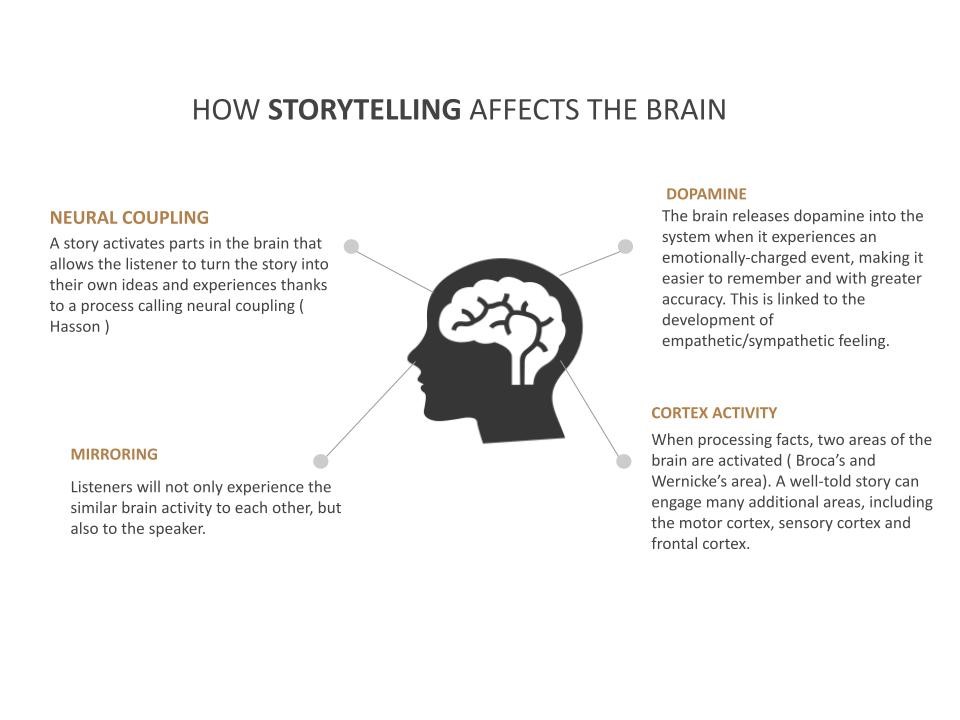
Stephens, G. J. et al. “Speaker-Listener Neural Coupling Underlies Successful Communication”. Proceedings Of The National Academy Of Sciences, vol 107, no. 32, 2010, pp. 14425-14430. Proceedings Of The National Academy Of Sciences, doi:10.1073/pnas.1008662107.
Perhaps it’s time to re-evaluate the way we teach, not via an objective lens, but an emotional one.
When we begin to put our educational institutions and real-world society side by side, we realize that schools are indeed microcosmic reflections of real world society. The parallels are astonishing. Our authority figures – governments, prime ministers, presidents, kings and queens, are at school our teachers, headmasters and staff. The “people”, who in the real world comprise of the rule followers and general economy-fueling citizens, are at school, our students, within whom the intricacies of social hierarchies and cliques naturally follow. The list of parallels could go on forever. When we begin to observe the correlations between school and the real world, we can understand that the significance of a school extends much farther than just the sole teaching of math, or english, but that schools serve as simulators to prepare us for living and collaborating in a society. Thus, if we want to raise culturally intelligent, empathetic leaders of tomorrow, we need to ensure that the reflection we produce within our schools is one of an ideal world. If that is a world of cultural and racial inclusion, a world free of the margins we face today, then that is the world we must reflect within our schools. For to make change out there, we must begin by making change in here, within our schools. That begins with what we teach and how we teach it.
Education is the foundation of life as we know it. With story-based EmoEmpathetic teaching, let’s create a world where no more little girls, no children, no men, or women feel cheated by their education – like I did.
So don’t tell your students what to, or not to do. The eternal prejudices of man cannot be understood objectively like 1,2,3 lists of mathematical equations. Tell them a story. Get your students to share experiences, and for just a minute, be vulnerable. Connect with one another. For our emotions are intrinsic qualities that define the human-kind, thus, don’t be afraid to use them. They are powerful.
So what are we waiting for? It’s time to tell a story.
“The human species thinks in metaphors and learns through stories.” – Mary Catherine Bateson
“Where there is a story, there is the power to teach” – Mehar Suri
Citations
- Hasson, Uri, et al. “Speaker–Listener Neural Coupling Underlies Successful
Communication.” Proceedings of the National Academy of Sciences of the
United States of America, 26 July 2010. National Centre for Biotechnology
Information, doi:10.1073/pnas.1008662107. Accessed 15 Oct. 2020.
- “How To Use Storytelling To Effectively Market Your Brand | Brand Marketing”. Echovme – Blog, 2017, https://echovme.in/blog/use-storytelling-effectively-market-brand/. Accessed 9 Apr 2021.
- Stephens, G. J. et al. “Speaker-Listener Neural Coupling Underlies Successful Communication”. Proceedings Of The National Academy Of Sciences, vol 107, no. 32, 2010, pp. 14425-14430. Proceedings Of The National Academy Of Sciences, doi:10.1073/pnas.1008662107. Accessed 9 Apr 2021.
Mehar Suri is a 16 year old ethnic-Indian global citizen studying at the International School of Amsterdam. Working with organizations such as the Anne Frank Huis, Stories that Move and AIELOC (Association of International Educators and Leaders of Color ), she is passionate about searching for and developing anti-discrimination tools in education. The founder of Care4buddies, a 45 member animal welfare organization founded in 2016, she is a lover of animals and a big advocate of vegetarianism. She is credited with the development of the principle EmoEmpathy.
LinkedIn
